The Ed Sheeran fight was never about the singer: it was about who owns the stage
Robert Kraft does not make music. He owns a stadium. When he and a bloc of NFL venue owners decided Macklemore would not open for Ed Sheeran, they exposed the thing this site keeps tracking from the Sydney Sweeney side: whoever owns distribution owns the show, and even pop’s most brand-safe star is a tenant.
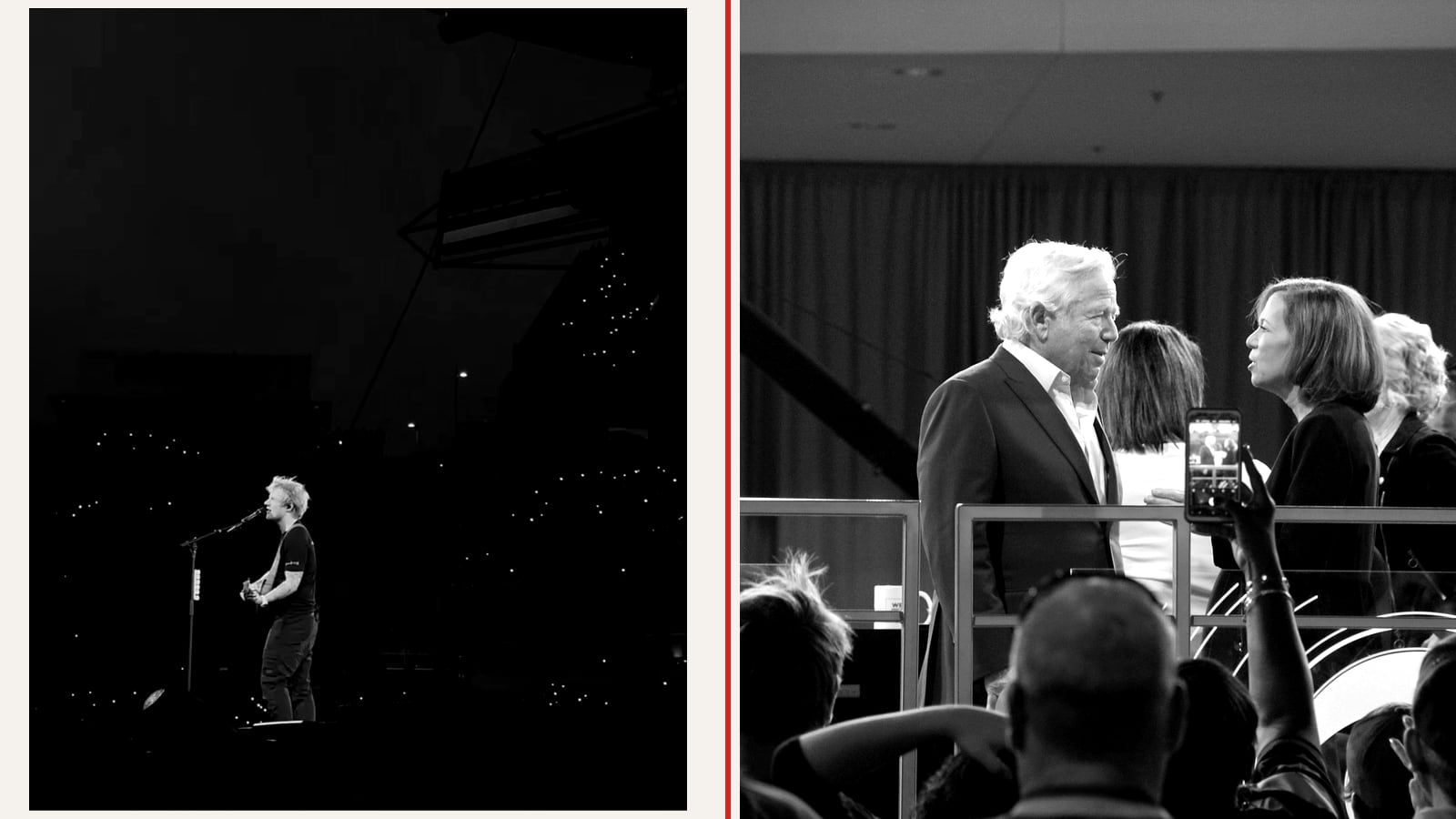
This site was built to watch how famous faces turn controversy into money, and the running case study is Sydney Sweeney, who manufactures the outrage and banks the attention because she owns a piece of what she is selling. The Ed Sheeran story has been covered everywhere as the mirror image, the brand-safe star dragged into a fight he did not pick. That framing misses the real actor in it. The person with the power here never sang a note. He owns a building.
The call that actually decided it
The trigger was the rapper Macklemore, who opened for Sheeran’s Loop Tour at MetLife Stadium on September 4, performed his protest song and said “Free Palestine” from the stage. What removed him was not a fan backlash. According to the reconstructed timeline of the controversy, Robert Kraft, the owner of Gillette Stadium where Sheeran was booked to play on September 25 and 26, called Sheeran for roughly forty minutes and told him that he and fellow NFL stadium owners, named in the reporting as Arthur Blank, David Tepper and Jeffrey Lurie, considered Macklemore’s comments hate speech and would cancel the shows if he stayed on the bill. On September 14 the promoter, Messina Touring Group, removed Macklemore, citing venues that refused to host him.
Sheeran said as much himself. In his September 15 statement he insisted the removal was “the promoter’s decision, it was not mine,” noted that Macklemore’s contract was with the promoter rather than with him, and warned that he was “deeply worried about the idea that venues could pre-approve content.” Read that last line slowly, because it is the whole story. The most bankable touring act in pop is telling you that the people who own the venues can decide who is allowed on his stage.
At a glance
- The owner
- Robert Kraft owns Gillette Stadium, a Loop Tour venue (Sep 25 to 26), and is not part of the music
- The call
- Kraft phoned Sheeran and, with fellow NFL owners named as Blank, Tepper and Lurie, threatened to cancel shows if Macklemore stayed
- Sheeran’s line
- Called the removal “the promoter’s decision, it was not mine” and warned venues should not “pre-approve content”
- The money
- Macklemore pledged about $1M to Palestinian aid and challenged Kraft; Kraft announced $2M the next day
- The cost
- Four acts walked, protests and a right-to-know request followed, and Sheeran changed production over safety fears
The star is a tenant
Here is where the Sweeney comparison earns itself instead of being forced. Our argument about Sweeney has always been that she is not a hired face, she is an owner: she holds equity in the thing the controversy promotes, so the outrage flows back to her as value. Sheeran is the opposite kind of powerful. He sells out stadiums, he is the product every promoter wants, and he still does not control the room. He rents it. When the people who hold the deed to the building formed a bloc, the biggest draw in the business became a tenant who could either accept their terms or lose the dates. That is not a story about one singer’s politics. It is a story about where power actually sits in live entertainment, which is upstream of the talent, with whoever owns distribution.
Then it became a bidding war
The money made the power visible. On September 16 Macklemore pledged the entire net of his tour earnings, reported at about one million dollars, to six Palestinian relief organizations, and challenged Kraft to match it. Kraft announced a two million dollar donation the next day, and said Sheeran had already asked him, before the public challenge, to commit that same two million to aid in the region. Set the optics aside and look at the structure: the artist who was removed and the owner who removed him ended up competing over who could give more to the same cause. When a dispute resolves into rival philanthropy at that scale, you are no longer watching a moral argument. You are watching two parties with the resources to buy the last word.
What the suppression cost
Trying to keep politics off the stage did not keep the peace, it moved the fight outside. Four of Sheeran’s supporting acts walked in solidarity, the exodus we covered in full in the companion piece on the anti-Sweeney playbook. By the Philadelphia show the fallout was operational. Philadelphia police planned a heightened presence as protesters gathered and a civil rights group filed a right-to-know request over who made the removal call. Sheeran changed his show’s production over concern for his safety, with metal detectors and pat-downs at the gates. The venue owners protected the buildings and handed the artist a security problem, a walkout and a news cycle that will follow him city to city.
Why it matters for the ad beat
We treat celebrity campaigns as a window on who really controls attention, and this is the same lesson from the distribution side. Brands spend on Sweeney because her provocation is a channel she owns. The Sheeran episode shows the other half of that market: the channels themselves, the stadiums, the platforms, the venues, are owned by people who can switch a performer off, and when they act together the talent has no counter. The outrage economy does not just reward the provocateurs. It answers, in the end, to the landlords.
What to watch
Watch whether any venue on the remaining Loop Tour dates publicly conditions the show on the lineup, which would confirm the pre-approval Sheeran warned about as a standing practice rather than a one-off. Watch whether other promoters quietly write venue-content clauses into future contracts. And watch whether Sheeran, who spent a decade avoiding exactly this, says anything further about the owners who made the call, or lets it rest now that the checks have cleared.
Sweeney Ad Watch is an independent commentary site with no affiliation to Ed Sheeran, Macklemore, Robert Kraft, Sydney Sweeney, or any organization named here. We cover this as a case study in the economics of attention and who controls distribution. We take no position on the underlying conflict. Every quote and figure above is drawn from the outlets linked in the text and listed below.


Sources & further reading
- Rolling Stone: Macklemore dropped from Ed Sheeran tour after onstage “Free Palestine” statements
- Variety: Ed Sheeran speaks out about dropping Macklemore (“the promoter’s decision, it was not mine”; venues “pre-approve content”)
- Wikipedia: Macklemore and Ed Sheeran tour controversy (timeline, venue-owner call, donations)
- Yahoo News: Opening acts abandon Ed Sheeran’s tour; Macklemore pledges $1M, Kraft matches $2M
- NPR: Ed Sheeran’s tour in trouble after opening acts drop out in solidarity with Macklemore
- CBS News Philadelphia: Police prep for Ed Sheeran concert as advocacy group demands answers over Macklemore’s removal
- Forbes: Ed Sheeran had to change his tour’s production over fears for his safety

The cost of being Sydney Sweeney right now: The outrage pays everyone except the person in the ad

The Sweeney ad outrage worked perfectly, because everyone got exactly what they wanted