She labeled it AI. Her sister did not. The backlash belonged to the CEO.
Jane Smith, CEO of Family First Credit Union in Saginaw, Michigan, posted an AI-labeled family photo before a Halifax trip. Her sister reposted it without the disclosure. The post went viral in Canada, death threats followed, and the family cut their vacation short. The board said it was "determining next steps." This is what the AI disclosure problem looks like when it lands in a corporate bio.
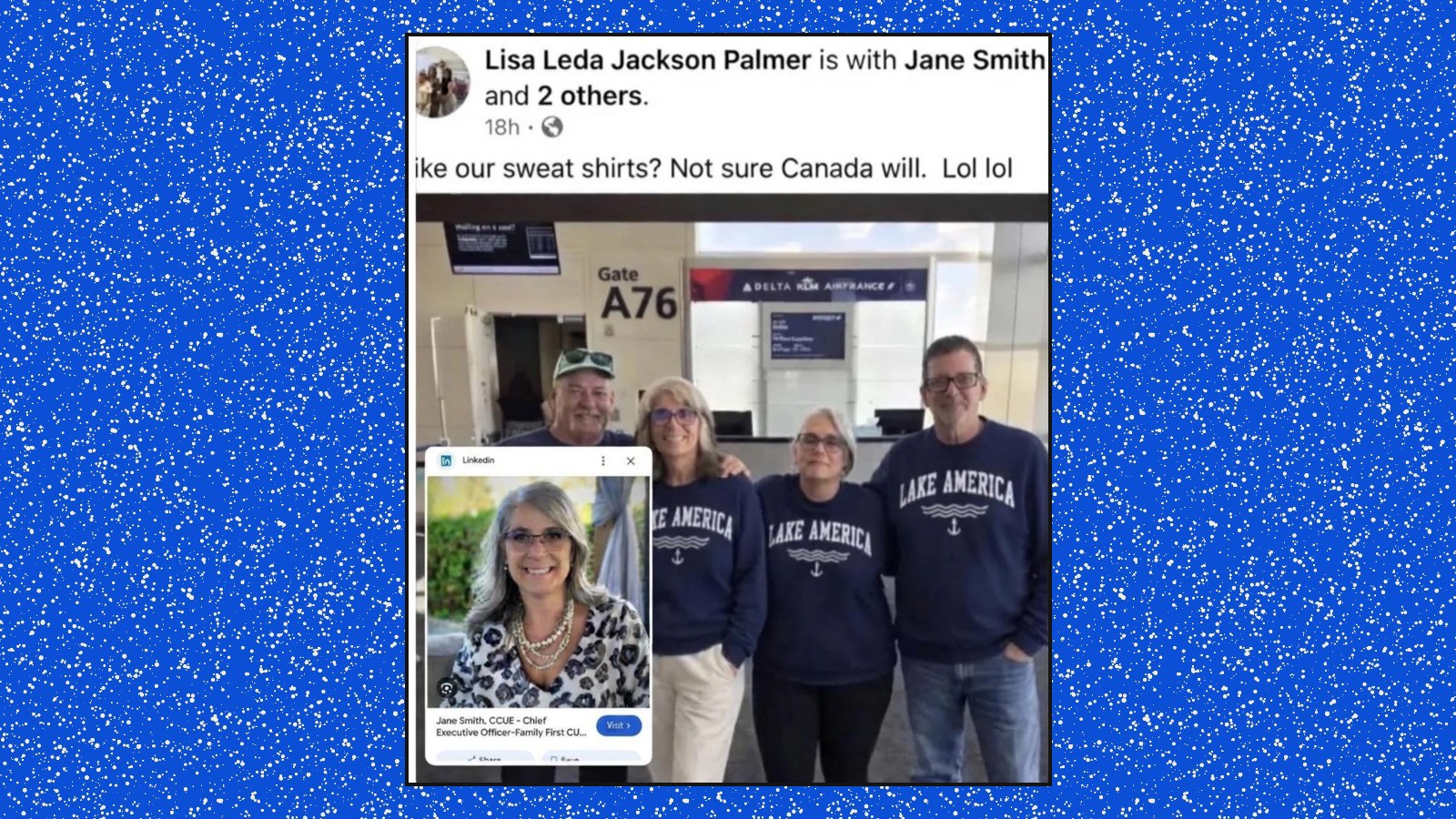
On September 11, 2026, Jane Smith, the CEO of Family First Credit Union in Saginaw, Michigan, posted a photo to her private Facebook page. The image showed Smith and three family members wearing sweatshirts printed with "Lake America," a reference to President Trump's August 2026 executive order renaming Lake Ontario. She labeled the post as AI-generated content and captioned it: "Like our sweatshirts? Not sure Canada will lol lol." She was about to fly to Halifax, Nova Scotia for a family vacation. Her sister, Lisa, reposted the image publicly from Halifax. The repost carried no AI disclosure.
What the repost did that the original did not
The image spread across Canadian social media as a genuine photograph of an American family celebrating a politically charged rename. Most of the people sharing it did not see the original labeled post. One Halifax resident commented that the group had "messed with the wrong city," according to PetaPixel's reporting. Smith began receiving death threats. The family cut their ten-day trip short and returned to Michigan.
At a glance
- The post
- Smith labeled the image AI-generated on her private Facebook before her Halifax trip, caption: "Like our sweatshirts? Not sure Canada will lol lol"
- The repost
- Her sister Lisa reshared it publicly from Halifax without the AI disclosure; the label did not travel with the share
- The consequences
- Smith received death threats; the family cut a planned 10-day trip short
- Smith's apology
- "I made a mistake. I own that mistake, and I am committed to learning from it." (via ABC12 / Credit Union Daily)
- Board response
- Called the post "unacceptable," noted personal capacity, said it was "determining the appropriate next steps" — no action announced as of Sept 22
- The AI lesson
- Smith: "AI can be dangerous in the fact that it can make people think something's real that's not." (ABC12)
Why this is an AI disclosure problem, not just a political one
The interesting thing about this case is not the political background. It is that Smith did several things that digital-communications advisers typically recommend: she labeled the content AI-generated, she posted on a personal rather than corporate channel, and she signaled clearly through her caption that it was a joke. None of it helped once her sister shared the image without that context. The AI label does not survive a screenshot. The original poster's framing does not travel with a repost. In the attention economy, the unit of meaning is the version that spreads, not the version that was originally posted. Smith herself arrived at this conclusion. She told ABC12 that "AI can be dangerous in the fact that it can make people think something's real that's not." She is right. And the lesson is structural, not individual: there is currently no mechanism that keeps an AI label attached to an image once it leaves the platform where it was posted.
Smith's apology and what she accepted responsibility for
Smith issued a public apology, describing the post as "insensitive, distasteful, and in poor judgment." She said: "Though the image did not depict a real event, I understand that the image was hurtful and offensive." She added: "I made a mistake. I own that mistake, and I am committed to learning from it." The apology is notably complete on the personal level. She is not blaming her sister. She is not blaming the AI tool. She is accepting the consequence of a post made in her name, regardless of the original disclosure. That is a reasonable personal response. It does not address the structural question, which is who is responsible when a labeled post is shared as real and causes harm.
The board's response, and what it reveals
Family First Credit Union's board issued a statement calling the post "unacceptable" and stating it "disapproves and rejects" the content. The board noted the post was made in Smith's personal capacity without the credit union's knowledge or authorization. It said the post did not align with organizational standards. It then said it was "determining the appropriate next steps." As of this writing, that is where the institutional response stands. Death threats were received. A vacation was cut short. The board said it is still deciding. That phrase, "determining the appropriate next steps," is not neutral. It tells the audience that the board is not sure whether what happened is a firing offense, a reprimand, or a private matter, and that uncertainty is now the institution's second problem.
What brand leaders should take from this
Family First is a nonprofit member-owned credit union, not a publicly traded company, but the communications dynamics are identical to any brand. The lesson is threefold. First, AI disclosure labels are best understood as fragile: they protect the original poster from some criticism but they do not protect the brand from the version that goes viral. Second, any executive with a title visible in their social bio is a brand representative on their personal accounts, regardless of what the employee handbook says about personal capacity. Third, when a reputational event reaches death threats and an early evacuation, "determining next steps" three days later is a statement about priorities, and audiences read it that way. The comparison that keeps coming back here is the Converse response to the Chuck 70 X imagery crisis: fast, unconditional, specific about what went wrong. Family First's response is the opposite: slow, qualified, and still unresolved.
Sweeney Ad Watch is an independent commentary site with no affiliation with Family First Credit Union, Jane Smith, or any organization named here. We take no position on the political question of Lake Ontario's name or the executive order that prompted the post. All facts above are sourced to the outlets listed below. Smith's quotes are attributed to ABC12 and PetaPixel's reporting; the board statement is attributed to the Credit Union Daily.


Sources & further reading
- PetaPixel (Sept 21): American CEO Forced to Leave Canada After Posting AI Photo of Family in Lake America Sweatshirts
- Yahoo News: Michigan Credit Union CEO Apologizes for AI Photo of Her Family in Lake America Sweatshirts
- CU Today: CU CEO Says AI-Doctored Lake America Photo Led to Death Threats, Cut Trip Short
- Credit Union Daily: CEO Issues Public Apology; Board Calls Post Unacceptable
- ABC12 Flint/Saginaw: Saginaw CEO in viral Lake America post voices AI concerns
- HCA Magazine: American CEO's Lake America sweatshirt photo sparks Halifax backlash